On the language learning of an earlier era — and what its slowness taught.
There is a particular quality of patience that learning languages required, in the years before the internet made everything available all at once, that I do not think the current generation of language learners can quite imagine. Not because they are less serious — many of them are more serious than I was at their age, and their tools are better, and their progress is faster. But because the quality of patience I am describing was not a virtue exactly. It was a condition. It was the simple structural fact of the period: that the language you wanted to be inside was at a great distance from you, and the distance could be reduced only slowly, by methods that depended on physical objects moving through physical space, and there was no way to circumvent the slowness because the slowness was built into the available infrastructure.
I want to describe what this was like, not to mourn it — I do not mourn it; the present is better in nearly every respect — but to record what it was, while there are still people alive who remember.
The primary tools were books. This sounds obvious, but it is worth saying carefully: when I began learning languages seriously, the book was not one tool among many. It was the central tool, the thing without which there was no learning at all. There were no podcasts. There was no streaming video. There were no apps. There was no YouTube to demonstrate the pronunciation of a word in twelve regional varieties. There were the books I owned, the books I could borrow from a library, and — if I was lucky — a small selection of cassette tapes or, later, CDs that came with some of the more ambitious textbooks. That was the inventory. That was what I had to work with.
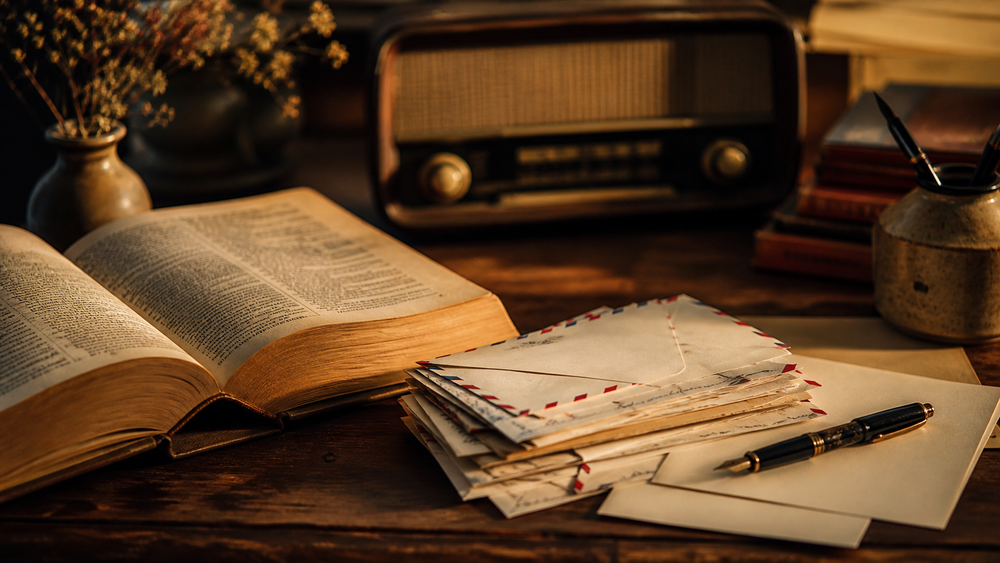
The books themselves had a specific weight that the term weight was not yet metaphorical for — they were heavy objects, each one acquired with some effort, often shipped from far away, often expensive, often the only copy of that particular book I would ever see. I read them with the kind of attention you give to something you cannot replace easily. I made notes in the margins because I knew I would return to those margins. I underlined sentences not because the underlining helped me remember them but because the act of underlining was itself a way of saying: this matters; I am claiming this; I want to find this again.
Reading a grammar book, in that era, was a sustained physical and mental project. You sat with the book. You read the chapter slowly. You did the exercises with a pencil because you might want to erase your answers later and try again. You looked up words in a paper dictionary, which involved finding the word alphabetically, with all the small navigational pleasures of moving through the volume — passing words you were not looking for, occasionally pausing to read their definitions. The dictionary itself was a kind of country. The looking-up itself was an event. It was not the seamless instantaneous consultation that the digital era has made it. It took perhaps thirty seconds. Thirty seconds is not a long time, but multiplied across the hundreds and thousands of words you needed to look up over the course of learning a language, those thirty-second intervals constituted a substantial portion of the work — and shaped the texture of the work in ways I do not think modern learning has quite replicated.
What thirty seconds of dictionary navigation did was give the word time to settle. The act of finding it, and the small accumulation of unrelated words you encountered on the way to finding it, and the moment of looking at the definition while still holding the book open with your other hand — this whole choreography produced a different quality of acquisition than a tap on a screen does. The word was earned. It was held. It became, in a way that I find difficult to fully articulate but felt unmistakably, more mine for having been retrieved through that small ritual. I notice that words I looked up in paper dictionaries decades ago I still know, while words I have looked up in phone apps in recent years I forget within hours. There may be many reasons for this. The dictionary ritual is, I suspect, one of them.
Then there was correspondence.
Before the internet made everyone available to everyone at all times, there was a thing called a pen pal. The institution of the pen pal — particularly the international pen pal — is, I suspect, almost extinct now, or at least so transformed by digital communication that what remains barely resembles what once existed. But for someone learning a foreign language in the era before email, the pen pal was the closest thing to genuine immersion most of us could get. It was the only way to practice writing the language to a real person who would actually read what you wrote and respond in their own version of the language, with their own errors and idioms and unique personality, across a distance that no other contact technology of the time could bridge.
I had pen pals — in several languages, at various points in my early language-learning years. I remember the pleasure of finding a pen pal address through one of the print directories that organized this kind of correspondence in those days. You would write a careful first letter — careful because it was the first impression, careful because it was being sent across an ocean, careful because the time investment of writing it, addressing the envelope, walking to the post office, paying for international postage, and entrusting the letter to the international postal system was significant enough that you wanted the letter itself to merit the effort.
Then you would wait.
The waiting was the strange part. Not the writing — the writing was familiar enough; everyone wrote letters in those days. The strange part, which I have come to understand was actually one of the most formative parts of my early language learning, was the period of suspended uncertainty between sending the letter and receiving the reply. Three weeks, sometimes. Four weeks. Sometimes longer. Sometimes a reply never came at all, and you never knew whether the letter had been lost, or the pen pal had decided not to continue, or some other small calamity in the postal infrastructure had absorbed your careful effort.
What I learned during those weeks of waiting was patience, but not the trivial patience of accepting a delay. I learned the deeper patience of trusting a process that was not under my control and that I could not accelerate. The letter was either going to arrive or it was not. The reply was either going to come or it was not. There was nothing I could do, in the meantime, to bring the process forward. So I read more books. I worked through more grammar exercises. I listened to my cassettes and my CDs. The waiting itself became part of the learning — the waiting taught me that languages were not things you acquired through impatience, that the gap between what I knew and what I wanted to know was going to be closed slowly and through accumulated work, and that there was no method of closing it more quickly that did not produce shallower understanding.
When the reply did come — and most of the time, eventually, a reply came — the experience of opening that envelope and seeing the foreign script and the unfamiliar handwriting and the small specific character of the paper they had used and the stamp on the corner was an event of a kind that I genuinely struggle to find an equivalent for in the present moment. I am not saying it was better. I am saying it was different. It had a weight that the instant exchange of digital messages does not have, because the weight came partly from the duration of the wait and partly from the physicality of the object and partly from the knowledge that this letter, this very letter, had been carried across continents to reach me and that the person at the other end of the exchange had taken the time to write it knowing it would also wait, on their end, before reaching me.
I learned French this way, in part — and Spanish, in its earlier years. The errors my correspondents made were more instructive than the errors corrected by any teacher, because they were the errors of real people writing about real things — about their families, about their towns, about the weather, about politics, about what they were studying — in a language that was their own, with all the small local turns and idioms that no textbook would have captured. I returned the favor with my own errors. We were teaching each other, mostly without knowing it.
The radio was the third tool, and it was less universally available, but for those of us who had access to it — through shortwave radio at the right hours, through a few ambitious local stations that broadcast in foreign languages, through the occasional cassette dubbed from someone else's radio — it was a kind of miracle. Hearing a language spoken by native speakers, in real time, talking about whatever the news of the day required them to talk about, was an experience I did not have access to in any other form. I listened to Spanish radio when I could find it. I listened to French radio. The signals were often poor, the comprehension was always partial, the content was frequently uninteresting — but the sheer fact of hearing the language used by people who lived inside it, doing what people who live inside a language do, was a contact that no book could have given.
I think now, when I have access to thousands of hours of native speaker audio in any of the languages I have ever cared about, that this earlier version of me — the one straining to make out a Spanish news report through static on a cheap radio, leaning toward the speaker with the posture of someone trying not to miss anything — was learning something the modern abundance does not quite teach. I was learning to want it. The scarcity of the access was producing a hunger that the abundance, however objectively superior, has somehow diminished. I do not know whether the modern learner has a better chance of becoming fluent than I had — they probably do, in raw efficiency terms — but I am not sure they have a better chance of becoming the kind of person who finds the language itself, the very fact of the language, to be one of the genuine pleasures of being alive.
I do not want to be sentimental about this. Sentimentality about technology lost is a familiar literary trap, and I am aware of falling into it as I write. The current era is genuinely better for language learners in nearly every measurable way. The access to native speaker content is incomparable. The tools for vocabulary acquisition and grammatical drilling are sophisticated beyond anything we had. The ability to find a tutor on the other side of the world and have a conversation with them this afternoon is something my younger self would have found magical in a way that bordered on religious. None of this is to be minimized.
But I notice, looking back, that the constraints of the earlier era produced certain habits of attention and patience and devotion that I have come to consider valuable in themselves — habits that I am not sure the modern environment cultivates as naturally. The slow looking-up of a word in a dictionary. The waiting for the pen pal's reply. The straining to hear a radio signal that fades in and out. The reverent treatment of the few books I owned, because I did not have endless others to compare them to. The discovery, in all of this, that languages reward the kind of person who gives them time — who shows up to them again and again, with small offerings, expecting nothing in particular, willing to work at the speed the work allows rather than at the speed the learner might prefer.
I am that kind of person, in some measure, because I had no other choice. The era I learned in shaped the temperament I brought to the learning, and the temperament has stayed with me through all the changes in technology that have followed. I read e-books now, I look up words on my phone, I have video calls with tutors in different time zones, I listen to podcasts in several languages, and I do all the things the present allows. But underneath those modern habits is the older habit, which I formed in the years of paper dictionaries and pen pal letters and shortwave radio: the habit of waiting, the habit of patience, the habit of believing that the language was worth the time it took, however much time that turned out to be.
I sometimes wonder what my younger self would make of the present. The paper dictionary I wore the corners of, replaced now by an app that translates entire paragraphs in seconds. The letters I wrote so carefully, replaced by messages that arrive instantaneously, in any of the languages I have learned, from anyone in the world. The radio signal I strained to catch, replaced by infinite native-speaker audio, available at any hour, free, in a quality the broadcast I once treasured could not have approached.
He would be amazed, I think. He would not be disappointed. He would be glad — for himself, that he is not having to work that hard anymore; for anyone learning today, that the tools are so much better; for the languages themselves, that they are so much more available to those who want to be inside them.
But I think he would also notice something I did not appreciate at the time, which I notice now. He would notice that the slowness was not only an obstacle. It was also a teacher. The slowness made the language a thing he approached carefully, valued highly, and treated with the kind of respect that produced the disposition I still carry, decades later, into every new language I encounter. The patience was not a virtue I cultivated. It was an inheritance from the era. And it has been worth keeping.
I have not forgotten any of it. The dictionaries, the letters, the radio, the cassettes — they shaped me. The languages I have inside me now were learned, in their first years, with those tools. And the person who learned them was, in important ways, made by the tools as much as by the languages themselves.
The present is faster. The present is better. But the slowness gave me what the slowness gives — and I am grateful for having had it before it disappeared.
— A.C. Maas